On iPhone, the system clipboard keeps exactly one item. If you want history - the ability to retrieve something you copied three screens ago - you need a third-party app. Here are the real options, what they actually do differently, and who should use which.
What to Look for in a Clipboard History App
Before comparing apps, establish the criteria that actually matter:
- Capture method: Does it run as a background daemon, a keyboard extension, or does it require you to open the app and paste manually?
- iOS sandbox reality: iOS prevents background apps from reading the clipboard silently. Every clipboard app on iPhone works by either being the active keyboard, being opened by you, or using a Share Sheet action.
- Search depth: Does it index the full text of every item, or only the first line?
- Privacy architecture: Local storage vs. cloud sync, and what the sync encrypts.
- Mac companion: If you work across iPhone and Mac, device sync matters enormously.
App Comparison Matrix
| App | Capture Method | Full-Text Search | Mac App | Cloud Sync | Price |
|---|---|---|---|---|---|
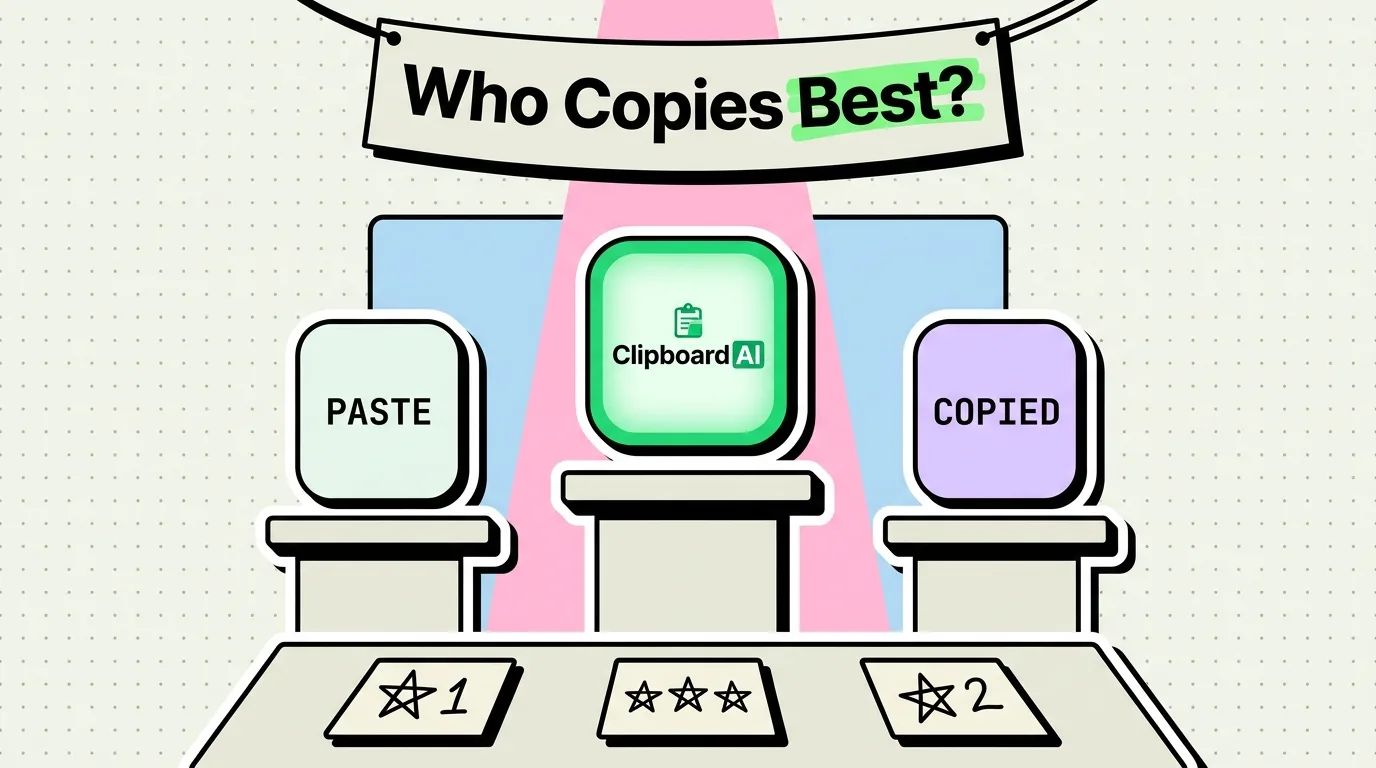
| ClipboardAI | Keyboard extension + app widget | ✓ | ✓ | iCloud (opt-in) | Free / Premium |
| Paste | Background service (Mac) + iOS extension | ✓ | ✓ | iCloud (required) | $29.99/yr |
| Copied | Manual paste-in | Partial | ✗ | iCloud | $5.99 one-time |
| Pastebot | Mac agent + iOS paste | ✓ | ✓ | Wi-Fi sync | $12.99 (Mac) |
| Clipboard Manager | App-based only | ✗ | ✗ | None | Free |
How Each App Handles the iOS Background Limitation
Apple prevents apps from silently reading the clipboard while in the background (since iOS 14's paste notification feature). Each app handles this differently:
ClipboardAI: Captures via keyboard extension - when the ClipboardAI keyboard is active, it sees what you type and paste. It also captures when you return to the app directly. The keyboard approach is the most seamless on iOS.
Paste: On Mac, runs as a background menubar agent with full system access - captures everything instantly. On iPhone, relies on you opening the app or using an iOS Share extension. Less seamless than on Mac.
Copied: Requires manual interaction on iOS. You copy something, then open Copied and it sees the current pasteboard. Good for intentional saves; not ideal for automatic history logging.
Pastebot: Similar Mac-primary model to Paste. Excellent on Mac, limited on iPhone due to iOS sandboxing.
Decision Tree: Which App Is Right for You?
Do you work primarily on iPhone?
  ├─ YES: Use ClipboardAI (best iOS keyboard integration)
  └─ NO: Do you work on Mac most of the time?
         ├─ YES: Do you want automatic capture on Mac?
         │        ├─ YES → Paste or Pastebot (full background Mac agents)
         │        └─ NO → ClipboardAI (opt-in capture, lighter footprint)
         └─ BOTH equally: ClipboardAI (best cross-device sync via iCloud, works well on both)
Pricing Reality Check (2026)
Paste at $29.99/year is the premium option. Over three years, that is $90 for clipboard history. ClipboardAI keeps your last 10 saved clips free, including search and the full paste keyboard. Pro lifts that cap and adds sync, at $19.99 a year or $34.99 once for Lifetime, so you can skip the subscription entirely.
For users who need clipboard history primarily on iPhone and occasionally on Mac, ClipboardAI's pricing structure makes significantly more sense than Paste's subscription model.
The Feature Most Comparison Articles Skip: Snippet Management
Clipboard history is retrieval. Snippet management is creation - pre-writing pieces of text you know you will need repeatedly, storing them permanently (not just until your history limit), and pulling them up by name or shortcut.
ClipboardAI and Paste both support pinned snippets with persistent storage. Copied supports "stacks" of saved items. Pastebot supports named rules and text transformations. This is often the feature that determines long-term app loyalty - not history depth, but how well it manages the text you deliberately save.